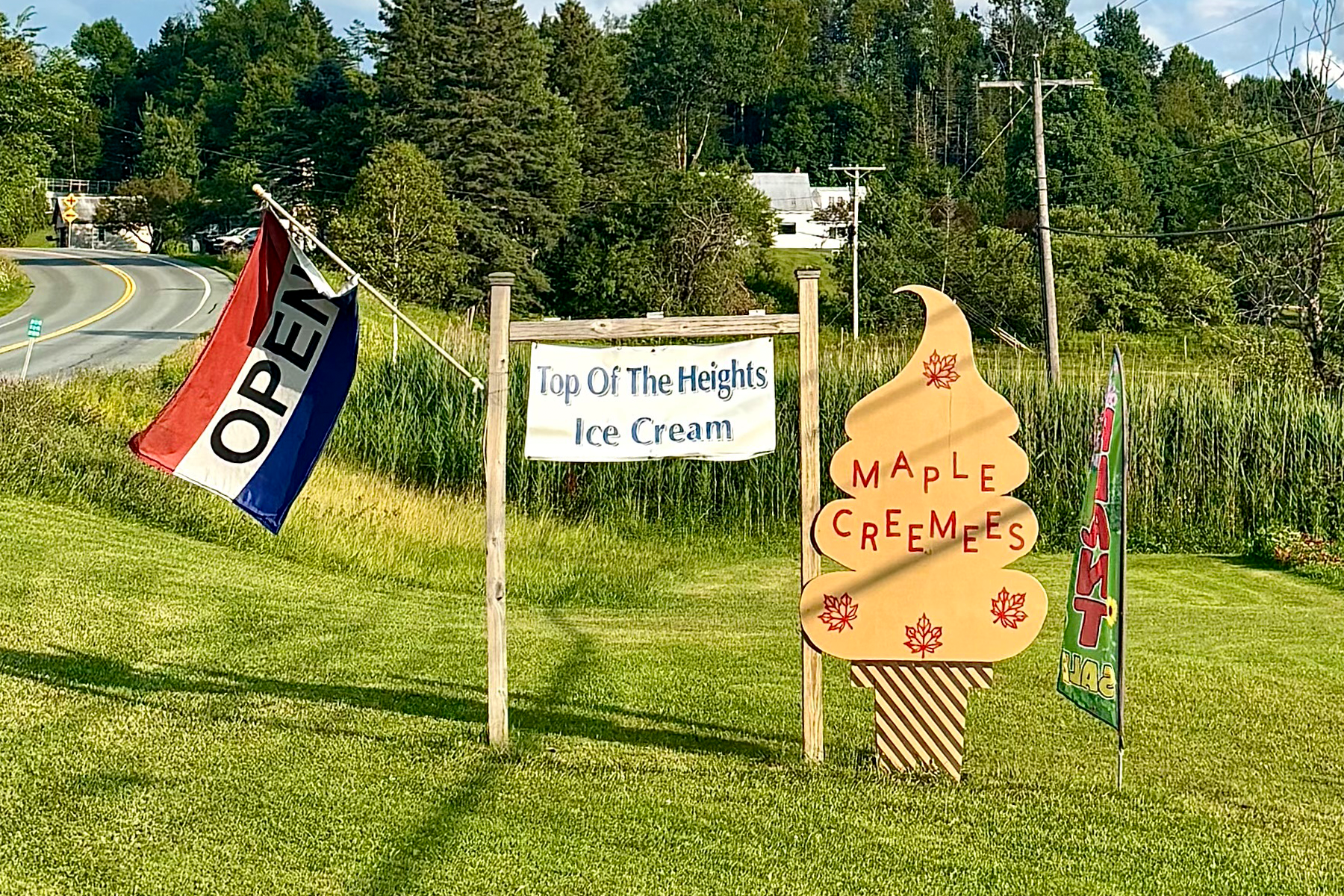
I’m not rating or ranking that experience because creemees are already an assiduously quantified and catalogued food. Eater’s existing roundup of best creemees provides a thoroughly researched range of recommendations. (If you want to really commit to the creemee, our newest cookbook, Eaterland, includes a recipe from Canteen Creemee Company in Waitsfield, Vermont.) When the Montpelier-based nonprofit news organization VTDigger got word that the Vermont Agency of Agriculture, Food and Markets tracks frozen desserts via its licensing system, reporter Erin Petenko filed a public records request and created an interactive creemee database.
This spring, Addison County resident Adam Rice began issuing the Vermont Creemee Passport. Though Rice earns his living in tech sales, he’s created a refreshingly analog method of charting creemee progress. You can purchase the paper passport for $10 on the website or in person at participating creemee stands, of which there are currently 88 (of 185 creemee locations across the state). Creemee purveyors pay $75 to participate and receive a custom stamp that makes each passport holder’s visit official; it’s up to the holder to record the date, tasting notes, and a rating. Proceeds from the nonprofit initiative go to HOPE Addison County, Vermont Community Foundation, and Voices for Vermont’s Children.
Since the Vermont Creemee Passport launched on April 15, Rice has issued more than 4,500 passports; donated over $5,000 to the Creemee Passport Action Fund, which allows passport purchasers to opt in with contributions that provide free creemees to kids in need; and raised $10,000-plus in donations from passport sales and merch. Rice openly acknowledges his own cultish commitment to creemees, and his state: “There’s this opportunity to indoctrinate people. When you come and you have five creemees from five different places, you realize how special Vermont is.”
Vermont's Secretary of Agriculture, Food and Markets, Anson Tebbetts, is filling his passport with stamps as he meets with constituents around the state. (He’s been going hard on maple-black raspberry swirl.) Like Vermont’s widely celebrated cheeses, the creemee can be an ambassador for the state’s dairy industry, which the sparse population and hilly topography keep small-scale. Vermont, as Tebbetts sees it, is competing on quality where it can’t compete on volume, “then taking that high-quality milk and making it into value-added products.”
Still, the reality of dairy production in this state and this century is increasingly complicated. Operators face shifting consumer tastes, an aging farmer population, and a shrinking industry. Not far from Heather’s house, in East Hardwick, Vermont, family-run Kingdom Creamery produces what the Vermonters I spoke to consistently cited as the gold-standard creemee base. People there were also talking about workers from Kingdom detained by U.S. Customs and Border Patrol, an ongoing stressor for dairy farms across the state that rely on migrant labor.
The creemee contains multitudes, if you’re paying attention. “To get to know the state and its history, why the landscape looks like it does, what motivates a lot of people and their sense of identity, you can visit these creemee stands,” said Amy Trubek, a nutrition and food sciences professor and director of the Climate Kitchen research hub at the University of Vermont.
An outsider’s perspective can even help counter what Chelsea Edgar, a Connecticut native who now lives in Montpelier, Vermont, called "creemee idolatry." Edgar wrote “A Haters Guide to the Burlington Creemee Scene” for the city’s Seven Days newspaper. “A really excellent creemee is something to celebrate," she said. "But we don’t do ourselves any favors if we just put all creemees on a pedestal, right?”
Edgar is not about to excuse ice crystals or air pockets. Setting is also crucial. She doesn’t want anything too twee. Her kind of creemee stand: Dairy Creme on Route 2. “It’s on the crumbling asphalt edge of a river. There’s just this feeling of entropy all around,” she said. “It’s like eating a creemee at the end of the world. And I will go out of my way to eat a creemee at the end of the world.”
Eaten any creemees or other frozen confections worth traveling for? Let us know at newsletters@eater.com.