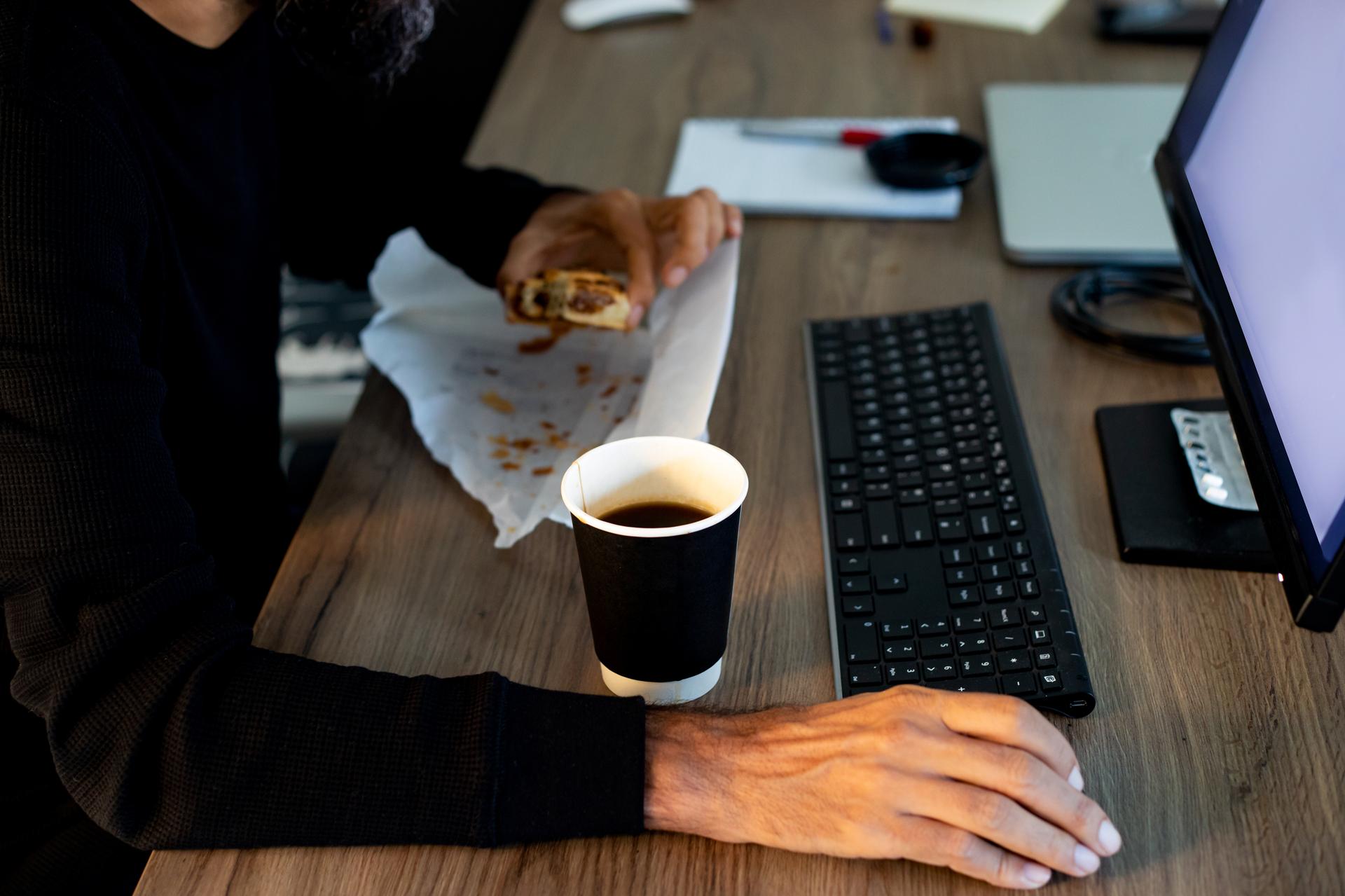
Humans have been hungry and time-strapped for as long as we’ve existed. So why haven’t we sanctified the concept of a lunch break like folks in Europe, Latin and South America, or China? Enter Mr. Monopoly, of course. In a recent survey shared with Eater and conducted by Zoom and Morning Consult (a consumer intelligence company), it’s clearer than ever that away-from-keyboard lunch breaks are disappearing, with 72 percent of participants saying they would rather skip lunch entirely than eat on camera. Consider some more of the responses of the 1,047 participants:
- 75 percent of knowledge workers (aka white-collar, office-job types) say they eat lunch while actively working at their desk at least once a week.
- Three in five say they use their lunch break for something other than eating.
-
72 percent say they’d rather skip lunch altogether than eat on camera during a meeting.
- Gen Z and millennial participants were 65 percent and 60 percent (respectively) more likely to eat on camera during a work call, compared to Gen X folks (38 percent).
I know, I know — Parisian readers are probably giggling as they read this during their pause déjeuner and puffs of Gitanes (did you know it’s technically prohibited to eat at your desk in France?). I surveyed my own Instagram followers (on a much more modest numbers scale, but one closer to my own demographic) about how often they had lunch AFK. Among the 88 participants, 48 percent said “almost never,” 34 percent said “daily,” and 18 percent said “sometimes.” (Those who said daily were overwhelmingly based outside of the United States, in either Europe or Latin America.)
The streamlined, away-from-home American lunch hour actually began in New York City around 1850, and it wasn’t until the turn of the century that it fell into the hours of roughly 12 and 2 p.m., when workers would head to the slew of shiny new drugstore lunch counters and automats for a bite. Sure, the world of meandering, boozy Mad Men-esque lunches existed, and it still does (the art of the schmooze is forever). But, in NYC and comparable manufacturing cities, life was work, and lunch became the sideshow. As culinary historian Laura Shapiro explains, “New York is emblematic [...] it has all the conditions that make America different from the Old World in terms of speed and work and the arrangement of life.”
COVID challenged this, but perhaps not deeply enough. According to the U.S. Bureau of Labor Statistics, companies actually clocked increases in productivity and performance among remote employees, prompting a huge shift away from strict-schedule five-day work weeks and in-office culture. But in many ways, I think this only ignites the curse of competence (meaning: even more work piled onto those who demonstrate efficiency).
Remote work allows us to complete various at-home tasks in our life with greater ease and flexibility (laundry, quick appointments, caring for pets), but it has damaged the dignity of the lunch hour; with WFH culture, it’s no longer a shared experience with colleagues, but a practice that requires self-reliance and effort. Before COVID, I primarily worked remotely (and I still do) but the occasional lunch out with a coworker or team always made me feel chummier and more aligned, as well as gave my brain a much-needed break from screen time. (In the above study, 57 percent of participants also said they focus better on complex tasks after even a 30-minute lunch break.)
There is a systemic solution to this mess, albeit one our country is particularly allergic to. In Revolution at Point Zero: Housework, Reproduction, and Feminist Struggle, Sylvia Federici underlines the importance of separating productivity from any moral virtue, if not a moral imperative (reasoning that in the eyes of the working class, it only leads to more exploitation). A tall societal order, no doubt. But Rome wasn’t built in a day, it was built by the guy who made it to the food hall for an (actually) ancient grain bowl.