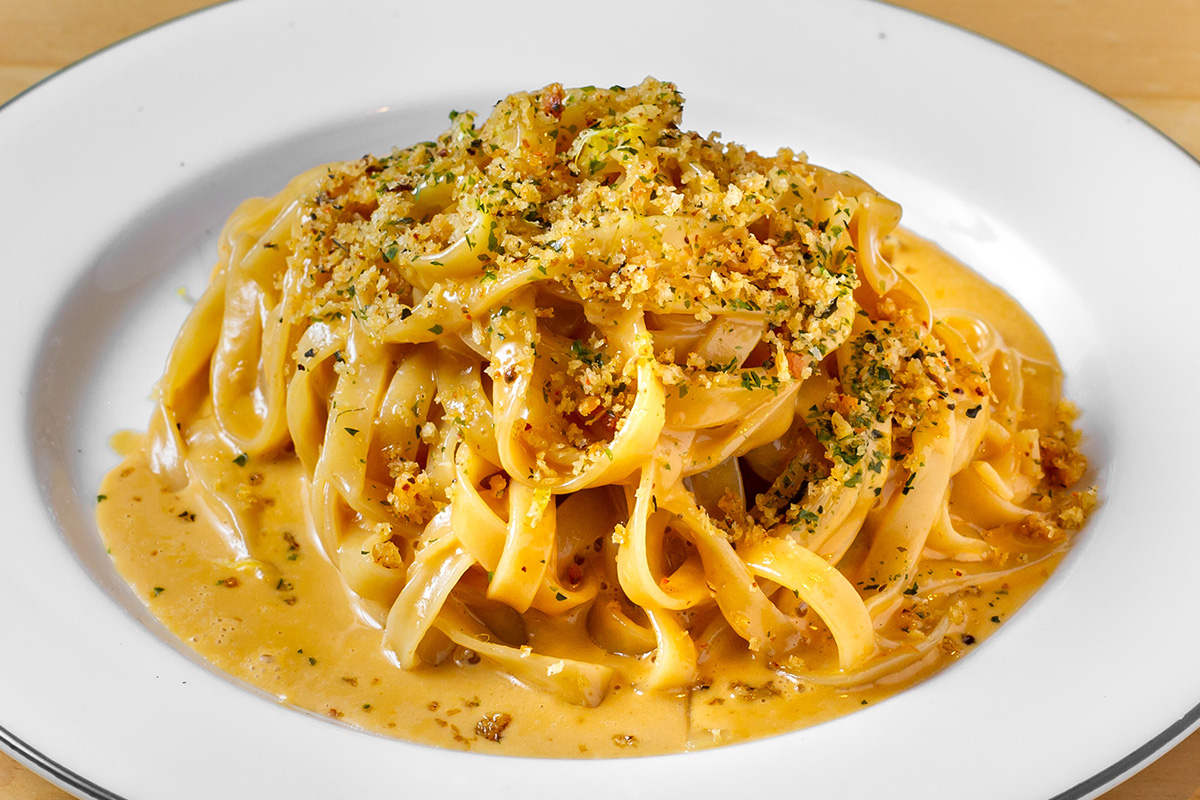
Last week, I went to a pizza residency where I tried two distinctly different interpretations of Japanese Italian food. |
|
|
Everyone loves Japanese and everyone loves Italian; now, what about Japanese Italian? |
Last week, the legendary Japanese pizza restaurant Seirinkan — whose owner Susumu Kakinuma is often considered to be the “godfather of Japan’s Neapolitan pizza scene” — popped up in New York City for a five-night residency at the Lower East Side’s Sake No Hana. For the residency, Sake No Hana had imported hundreds of pounds of Kakinuma’s special flour from Japan, its bags marked with a cartoon logo and the initials “SK,” plus his special Italian tomatoes of choice.
Though Kakinuma has pushed back on the idea that his pizzas are stringent to Italian tradition, calling them “Kakinuma-style” over strict Neapolitan, Seirinkan is a purist’s pizza. For the residency, the restaurant served a margherita pie, a marinara pie, and a white pie. The latter was the most boundary-pushing of the three, in the sense that it was served with preserved cherry blossoms and freshly grated wasabi, which was a surprising but welcome way to cut the dairy’s richness.
While the pizzas constituted something closer to traditional Italian food — I’d argue that most eaters would call it hypertraditional — the rest of the collaborative menu did not. Take, for example, the wafu carbonara, in which chewy udon noodles were tossed in a creamy sauce with a poached egg, shaved truffle, and dollops of uni. It was undeniably Italian carbonara, yes, but it also tasted and felt distinctly Japanese, with noodles that were more bouncy than they were al dente.
|
|
|
Part of why I wanted to check out the Seirinkan dinner was that I’ve been reporting a piece about the rise of Italian Japanese restaurants — as in, places that merge both cuisines for dishes that feel distinctly novel — across the United States. Some of these, like the carbonara, bill themselves “wafu Italian.” In the context of dishes like this, “‘wafu’ means Japanese in style, but it’s an adaptation of a foreign dish,” cookbook author Sonoko Sakai of Wafu Cooking told me in a phone call. This style of cooking has a long history in Japan, she explained, with the restaurant Kabe No Ana, which opened in Tokyo in 1953, generally credited as the birthplace of wafu pasta.
Other restaurants bill themselves “itameshi,” a term that literally means “Italian meal” but that is also used to refer to Italian Japanese fusion. Others are some variation on “Japanese and Italian.” Whatever you call them, these are restaurants that serve dishes such as mentaiko corn pizza and cacio e pepe gyoza, and they’re now popping up all over the country. Consider Kinjo in Tampa; Ama and Ciaorigato in San Francisco; Miso Mozza in Providence, Rhode Island; and Itameshi in Albany, New York, all of which have opened within the past year alone. There are older places like LA’s Orsa & Winston; Washington, D.C.’s Tonari; NYC’s Kimika; and Montclair, New Jersey’s Pastaramen. Everyone loves Japanese and everyone loves Italian. Now, these restaurants ask, what about Japanese Italian?
Read my full story about the rise of Japanese Italian food and why it feels so relevant to the modern American dining scene here.
|
|
|
|