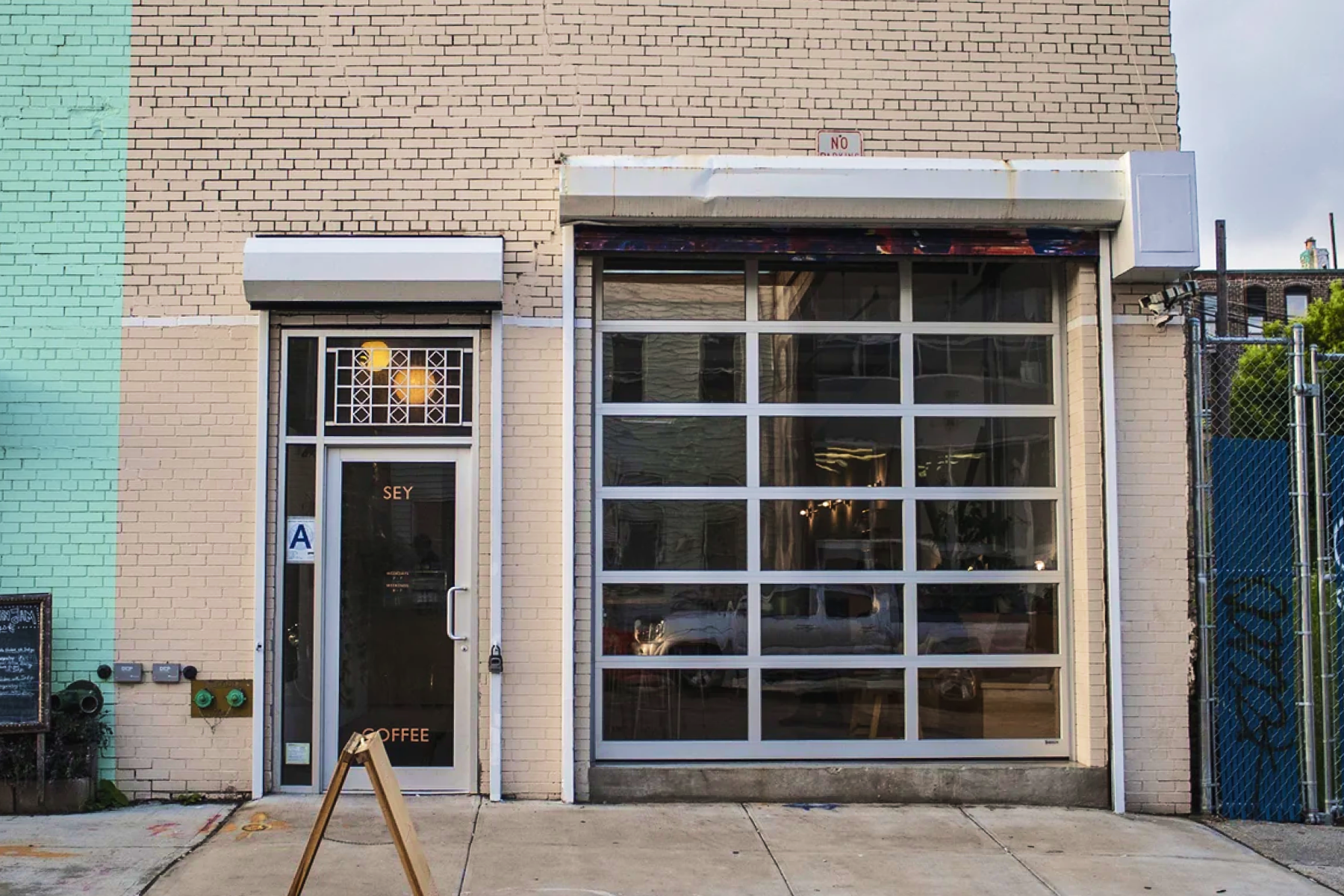
These days, Bushwick is perhaps best known for its graffiti art, ecuavolley, and queer bars; the Brooklyn neighborhood is famous for its family-owned taquerias, American-Italian pastry shops, and the hallowed grounds of the Girls episode where Shoshanna accidentally does crack and runs around pantsless at a warehouse rave. Situate yourself at the heart of its largest park, Maria Hernandez, and you’ll see a kaleidoscopic blend of ravers, Latino families, and the baklava guy.
Starting this week, it’s also home to a $200 cup of coffee.
Bushwick’s Sey Coffee recently announced that it would be touring a rare Panamanian geisha from Finca Sophia, a coffee farm in Panama’s Chiriquí highlands. Sey scooped up the geisha at auction for $44,275, which comes to $6,325 per kilogram, or roughly $200 per cup. The geisha is billed as extraordinarily aromatic, floral, and juicy; Doug Cohen, Sey’s director of brand strategy, advises enjoying it with a clean palate, completely black, and taking your time with it. “As the coffee cools, different aspects of its character become apparent, and that evolution is part of the experience,” he says.
Even among fourth-wave coffee shops where prices continue to climb higher, Sey’s $200 cup is an outlier. “Coffee as a premium product is relatively new,” says Cohen. “For so long, coffee has been treated as a commodity, and its value has been constrained by that perception.” He says that both before and right after COVID, folks were becoming more curious about coffee, and educating themselves on platforms like YouTube, Discord, and online forums about how to appreciate it and “understand just how high the ceiling of quality can be.” The arrival of the $200 cup of coffee from a cafe in a neighborhood at the epicenter of conversations about both culinary innovation and gentrification feels ripe for closer examination.
So, how did this coffee end up at this price? “We have been purchasing coffee from Finca Sophia for several years,” Cohen says. “This release really grew out of that existing relationship.” When Finca’s general manager told Cohen that the farm’s yields were down by approximately 95 percent, Cohen says a bigger question was raised: “What does it mean to be a good partner when the people you have built relationships with are facing a difficult year?” Buying up the geisha beans felt like a way to both support Sey’s producer, and further develop what Cohen calls “elevated coffee experiences.”
In the 2010s, the artisanal coffeehouse wave washed over the country, and especially Brooklyn, with hipster gusto. Sey Coffee was an integral part of that boom. Initially called Lofted Coffee, it operated out of its founders’ Bushwick loft until it rebranded to Sey in 2017, and expanded operations to its present Bushwick location on Grattan Street. That space has become something of a local icon since; Sprudge called its aesthetic “shoebox crossed with an airplane hangar”; the minimal-industrial, cream-hued interiors hit a very Axel Vervoordt-with-a-cyber-sigil-tattoo note (positive). The shop’s cachet has drawn coffee lovers, artists, yuppies, and artist-yuppies; customers have snacked on the gluten-free pastries from L’imprimerie (and now, post-L’imprimerie closure, pastries from Smør), and often post up with their dogs thanks to the semi-indoor-outdoor layout.
Sey is hoping to elevate the coffee shop model to something more premium, with a stated focus on ethics and sustainability. Thus far, it’s earned acclaim for those efforts. Food & Wine named it the best coffee shop in New York and received positive media attention for opting out of tipping, choosing instead to pay its staff up to more than 80 percent above the NYC hourly minimum wage; full-time baristas can make up to $31 per hour in addition to receiving benefits and a share of the cafe’s revenue.
Increasingly, coffee is getting the same treatment as high-end dining and tasting experiences. There’s the omakase-style menu at NYC's Driftaway Coffee, or San Francisco’s Komakase coffee tasting room, both of which steer coffee away from quick consumption and toward a world of degustation that appears to have more in common with pricier wine and spirit tastings. The expansion of “espresso house” chain Watch House stateside is also an indicator: The London-based specialty roaster expanded to a fourth location in New York City this summer, raising eyebrows for its $32 cup of coffee while also reportedly scouting for more locations in Austin, Chicago, and Miami.
The emerging demand may be just much about luxury as it is about craft. I can’t help but wonder if the $200 cup of coffee is happening in Bushwick because the Girls-era Bushwickian has grown up and wants more exclusive experiences. Is this what happens when, as culture writer Raven Smith said on his new BBC podcast last week, the indie outgrows its sleaze? “For us, this is not about pushing prices higher for the sake of it,” Cohen says. “It is about challenging how we assign value to coffee in the first place. What is an extraordinary coffee actually worth?”
As much as we may lament climbing prices for specialty coffee and espresso, why wouldn’t this happen to the category when so many other aspects of food and beverage — from cocktails to sushi to bread — are following the same trajectory? Higher consumer costs notwithstanding, the marketing of specialty beans does steer U.S. coffee culture away from its productivity-focused consumption and the work-optimized “coffee break.”
“Why do we accept that certain wines can command thousands of dollars, yet question whether coffee can have comparable value?” Cohen asks. It’s a fair question, albeit one that I’d answer with another: Once we acknowledge that coffee should command a higher price, who still gets to drink it?