Hi, and happy Monday. Welcome back to our series How I Got My Job, where we ask hospitality pros from all corners of the industry how they got here and what their role is really like.
This week, staff writer Francky Knapp chatted with the chef behind a culinary design studio to hear about how he makes catering more artistic, more sustainable, and more “life-changing.” Read on for her interview, plus the latest industry news, a controversial coffee shop charge, and a handful of hot hospitality jobs right now. |
—Mary Anne Porto, senior editor |
|
|
How I Got My Job as a Chef and Founder of a Culinary Design Studio |
Bob Spiegel is the executive chef and founder of Pinch, a New York City-based culinary design studio and catering company. Known for pairing a zero-waste ethos with an artistic and often architectural approach, Pinch’s globally trained chefs and in-house design team have served churros on parasols and extra-long, swirly bouquets of pretzel grissini; Calder-esque chip mobiles, and 10-foot long trays of lobster mofongo that unfold like an M.C. Escher staircase. As Spiegel tells me, “We dream and conceive of these concepts 22-23 hours a day.”
|
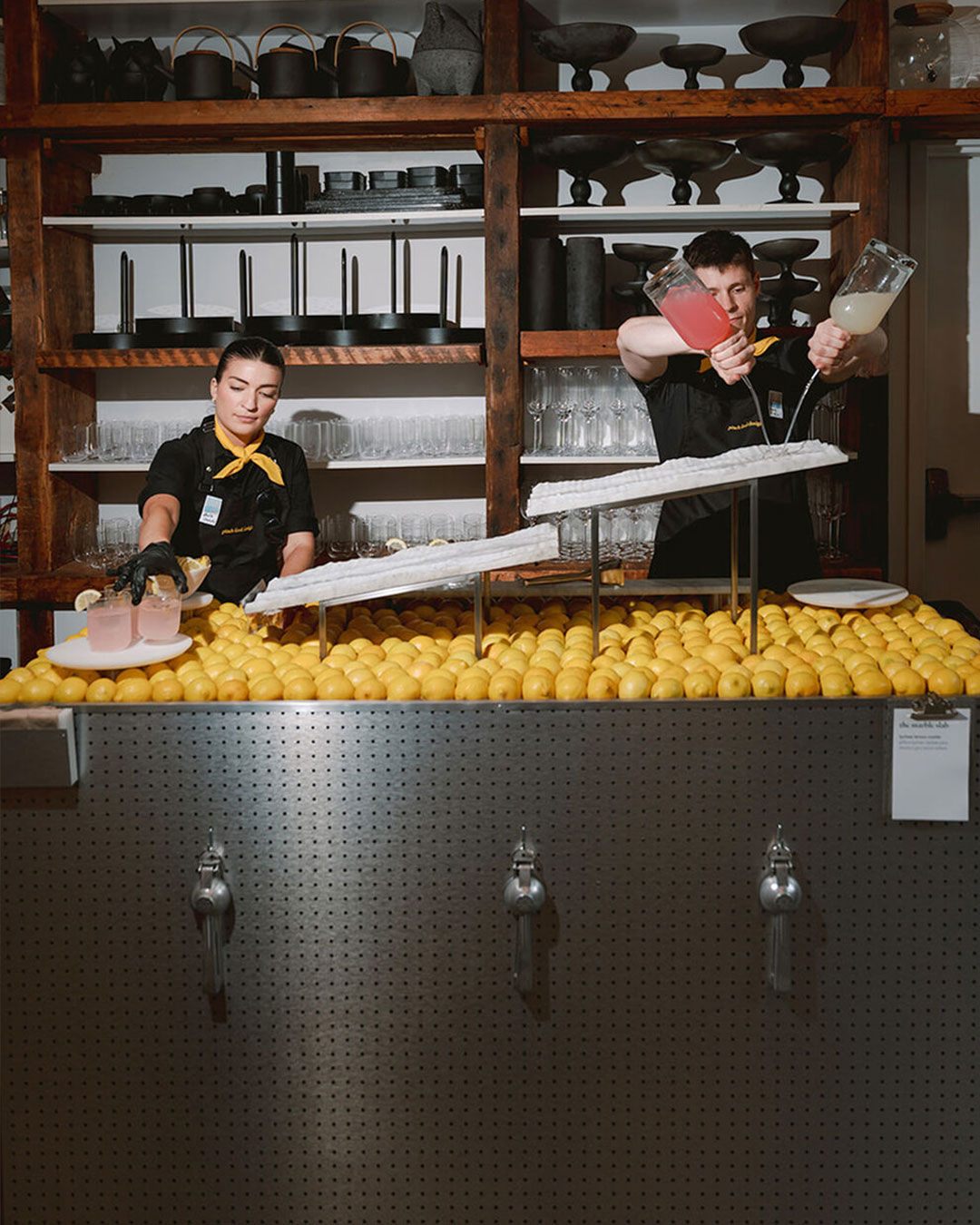
A drinks station designed by Pinch. | Pinch Food Design |
Francky Knapp: What exactly is a culinary design studio? |
Bob Spiegel: Pinch Food Design was created to raise the catering experience to that of restaurants. We wanted guests to have life-changing food experiences at these events.
I'm the chef and founder [and] I co-create with Pinch's creative director and business partner Marjorie Artieres. Marjorie designs Food Furniture, coupled with our food and bev experiences, [and] we are usually challenging each other with food serving problems, [like how to] immediately satisfy 500 guests after a museum presentation, design pieces filled with handheld foods, or [create] fun passed grazing plates.
|
Did you always see yourself in a role like this? |
My mom always emphasized the arts. I never thought I would have my own business; I still love the whimsy and chemistry of cooking. After culinary school I started my NYC catering career in 1983, where I was trained as sous chef under master chef Jean-Claude Nédélec.
I got into catering after working in restaurants because I loved being in a different venue every day, and my mind needed a lot more challenges while holding a high culinary standard. The challenges—for example, to serve restaurant quality food in places like the New York Public Library or in a large warehouse without having a restaurant-quality kitchen—is a rush. Also, plating in catering is not restricted to plates, bowls, or platters; we have all types of food serving canvases consisting of heated displays, which are usually kept in the kitchen at a restaurant, but [for us are] near the dance floor as part of the event.
| What’s a typical day of work like for you? |
I come in [and] say good morning, and then we are in our bubble. We are creating, developing, adjusting, critiquing and tasting food and bev design inventions all day long. All of the 350+ annual events we cater are unique in some way. |
What are some of the most memorable creations you've done/events you’ve worked on? |
Being a chef forever, I love the challenge of miniaturizing a meal into a one-bite hors d'oeuvres. For example, for over 10 years I worked on mastering the flavor and texture of spaghetti and meatballs into a single bite. The solution was a sensation of perfectly al dente pasta, followed by a flavorful meatball and sauce, all packed into a single bite that does not require boiling pasta. It’s a win… because of course, you can't boil pasta at the MoMA. |
How did you figure that out? |
At first, I experimented with more literal interpretations, filling a rigatoni with a meatball mixture, or twirling spaghetti onto a fork and topping it with a miniature meatball. But ultimately, I took a different approach. I created a simple yet flavorful Tuscan tomato sauce, set lightly with agar, then rolled angel hair pasta and sliced it into small disks. The short-cut angel hair pasta delivers the sensation of al dente in a single bite. [Now] we make thousands of these. |
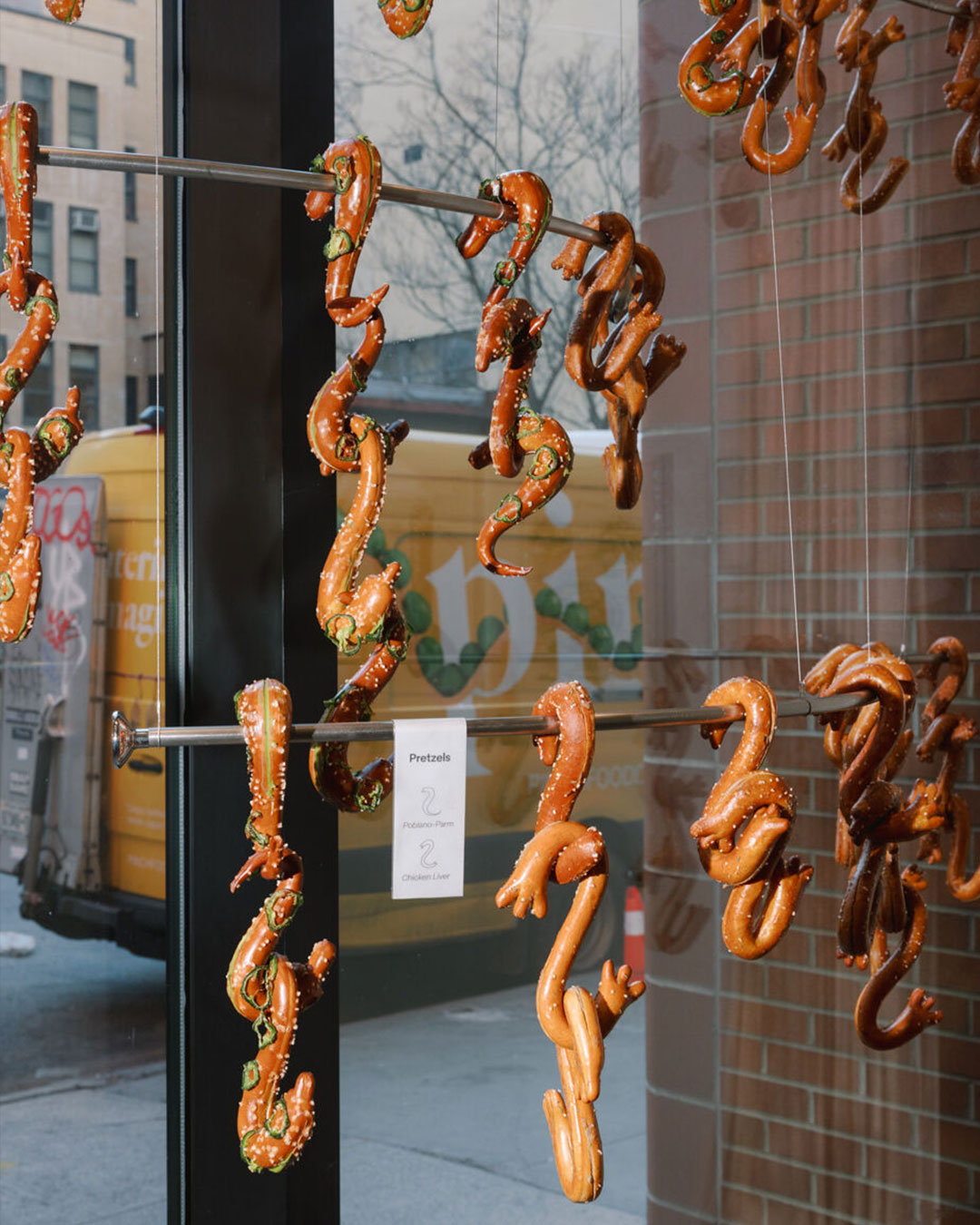
A pretzel hook display designed by Pinch. | Pinch Food Design |
|
|
Pinch is also zero-waste. How do you approach sustainability? |
Everything at Pinch is either composted or reused in a different form, like a cocktail made of [leftover] preserved juiced lemons or a carrot beet shrub made from peelings. No food goes into the trash.
Being sustainable is really important to us. We had a pandemic year of no gatherings of 10 or more people, so we used that time to partner with Columbia University’s Earth Institute to find all the upstream and downstream sustainability issues of a catered event. Our furniture is all made from sustainable materials such as reconstituted plastic from ocean waste. Now, it is part of our culture, [the task of] separating compost and G2 plastic recovery. If our truck could run on coffee grinds, that would be a game changer.
|
What advice would you give for someone trying to get into your line of work? |
At Pinch, we all [have] either a culinary background, service background, or some type of art background. Marjorie has a master's in industrial design and product design, she is also a food expert. To work at Pinch, you need to possess a high level of curiosity, a need to experiment, and the desire to scale anything that we create so it is easily replicated for our events. You have to love to improvise, but follow the rules at all times. Catering one party a week is doable, but catering 60 involves serious system [discipline] and communication.
Now is a great time to do anything in the food design spectrum; so many people are into food these days and most have a desire for something they haven't seen or experienced before. The key is to take risks and don't take yourself too seriously, because it's food and a party. It needs to be fun. Responses have been lightly edited and condensed. |
|
|
“It’s not wrong or bad to want to come together and share our grievances and our ideas for how to make the workplace and the industry better.” Workers at the New York bar Attaboy have announced that they are forming a union.
“There’s a preconception that there’s a risk in hiring autistic individuals. The real risk is overlooking incredible talent.” Chefs on the Spectrum is a new program training people with autism for fine dining jobs.
“No need for us to tell you how much the price of everything has gone up.” To offset high costs and reduce single-use plastic waste, one coffee shop has started charging for to-go cups. |
|
|
| Here’s a handful of hospitality jobs available right now: -
Little Flower Cafe, a Queens coffee shop that counts Zohran Mamdani as a fan, says it’s looking for a videographer/editor.
- In D.C., the group behind spots like Mother Wolf and Desert 5 Spot currently has an upcoming open call for all roles at a new restaurant and lounge.
-
Black Farmers Collective, a Seattle-based organization centered on "Black liberation through food sovereignty" and food system education, is hiring for a handful of roles.
-
Elbow Bread, an Eater-favorite bakery in New York, shared that it’s looking for an “experienced PT barista” via Instagram story. Interested candidates can email the bakery.
- Maple & Ash, the steakhouse chain, is looking for a butcher for its forthcoming Boston location.
-
Oyatte, a new Korean fine dining restaurant in New York, seeks a sous chef and chef de partie.
If you have a job to share or intel on these roles, as always, reach out to Pre Shift. |
|
|
Pre Shift is for the trade, and by the trade. We want to bring in your voices and hear your ideas. Have thoughts? Let us know by emailing preshift@voxmedia.com. If you like this email, please forward it to a friend. If you aren’t signed up for this newsletter, you can do so right here.
|
|
|
This email was sent to knappmaryfrances@gmail.com. Manage your email preferences for Eater or Punch or unsubscribe.
View our Privacy Notice and our Terms of Service.
Vox Media, 1701 Rhode Island Ave NW, Washington, DC 20036.
Copyright © 2026. All rights reserved. |
|
|
|